
The Well Minds Lab conducts translational neuroscience and applied psychological research on the three following themes:
Mental Health and Wellbeing Neurodevelopment
While the current mental health and wellbeing crisis in children and adolescents is regularly making headlines, effective support and prevention remains limited. One of the reasons for this is the lack of research on the psychological and neural processes underpinning mental health and wellbeing (MHW) development. Such understanding is needed to inform effective age-appropriate and continuous prevention and intervention strategies. To help address this research gap, Dr Dorjee formulated The Neurodevelopmental Theory of Mental Health and Wellbeing Capacities (NDeTeC) (Dorjee, 2024).
Based on an extensive integrative review of relevant research evidence, the NDeTeC applied a transdiagnostic perspective to propose two key capacities underpinning MHW – the self-regulation capacity and the self-world capacity. The self-regulation capacity specifies neuro-cognitive-affective processes underpinning adaptive management of thoughts, emotions and behaviours in support of long-term MHW. The self-world capacity specifies neuro-cognitive-affective processes underpinning relational aspects of MHW that support development of a connected, flexible, ethically-grounded and purposeful sense of self in support of long-term MHW. Both of these capacities are in the NDeTeC linked to a particular constellation of activity in e large-scale brain networks.
To enable empirical evaluation of the theory, we have developed a measure of the two MHW capacities called the Developmental Inventory of Mental Health and Wellbeing Capacities (DIWeC) (Dorjee & Nguyen, in prep.). We are now in the second phase of validating this measure in adults. The next steps will be an adaptation of the measure for assessments with children and adolescents. We are currently also conducting the first study to investigate neural correlates of the two capacities using event-related brain potential indexes.
Further ongoing research in the lab building on the NDeTeC framework is exploring teachers’ understanding the role of these capacities in supporting their pupils’ MHW. We are also examining possible applicability of the capacities in equipping adolescents with foundational MHW skills on which they can build in developing their future-ready skills (skills young people need to manage the complexities of fast-changing job markets and societal shifts).
The NDeTeC is a translational neuroscience framework, formulated both to enable further rigorous research on MHW neurodevelopment and to facilitate timely ‘translation’ of such understanding into educational and healthcare practice and policy. Therefore, we collaborated with the PSHE Association, a leading provider of PSHE teaching materials to schools in England, on developing a comprehensive MHW curriculum for primary schools – called The Foundations for Wellbeing – based on the NDeTeC. This work was conducted over two years (2023-2024) as part of a KTP project funded by UKRI Innovate UK. This short article describes the research reasoning behind this project. And Dr Dorjee’s latest book – Making Sense of Mental Health and Wellbeing in Primary Schools: A Practical, Neuroscience-Based Guide – explains in an accessible way how the NDeTeC framework can be introduced into school curricula.
Developmental Contemplative Neuroscience
Nearly one in five adults in the UK and USA practices some form of meditation. Indeed, meditation-based interventions, particularly mindfulness-based approaches, have over the last two decades been implemented in many mainstream settings – including healthcare, education and workplaces – as a way of supporting MHW. Contemplative neuroscience is a new field of research examining changes in neural and psychophysiological processes resulting from contemplative practices such as meditation (including mindfulness, compassion practices etc.), prayer, contemplative yoga and other approaches.
In the Well Minds Lab we aim to expand our understanding of the effects contemplative practices have on MHW from a developmental translational neuroscience perspective. We have formulated theoretical foundations for such research through narrative reviews (Sanger & Dorjee, 2015; Kaunhoven & Dorjee, 2017) specifying possible effects of contemplative practices on self-regulation in children and adolescents. We have also proposed ways to investigate these effects using a range of event-related brain potential (ERP) indexes.
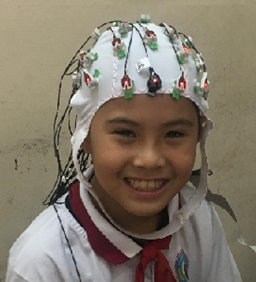
Building on these theoretical foundations, we have conducted several longitudinal studies investigating changes in ERPs as a result of school-based mindfulness interventions. We have completed two non-randomised controlled studies (Wimmer et al., 2023; Kaunhoven & Dorjee, in prep.) and one randomised controlled study (Nguyen & Dorjee, 2022) with pre-adolescents, and one non-randomised controlled study with older adolescents (Sanger & Dorjee, 2016; Sanger, Thierry & Dorjee, 2018). In all these studies we collected EEG data in experimental tasks in schools, combining lab-based experimental study rigour with advantages of inclusive naturalistic approach to data collection (involving children who would otherwise be unlikely to attend a study conducted in a laboratory setting).
To advance research in contemplative neuroscience and psychology further, over the last five years we worked on developing and validating new comprehensive self-report measures assessing cognitive, affective and motivational processes modified in meditation. These measures are included in the Mechanisms of Contemplative Practice Inventory (MCPI) which was formulated based on the Mechanism of Contemplative Practice Framework (MCPF, Dorjee, 2016; Dorjee, 2017). This framework specifies the key processes modified by meditation in terms of the metacognitive self-regulatory capacity (MSRC) and modes of existential awareness (MEAs – overarching states of awareness reflecting one’s sense of self and reality) that are modulated within a particular context of contemplative practice with intentions one brings to their practice.
Based on the MCPF framework, the MCPI consists of three measures. The Inventory of the Metacognitive Self-regulatory Capacity (IMSRC) measures contemplative practice-induced changes in metacognition and attention, rumination and emotion regulation, and healthy emotional qualities such as loving kindness and compassion. The Inventory of Modes of Existential Awareness (IMEA), a measure that has now been validated and is available for use in research studies (Dorjee, Nguyen & Märtins, 2025), assesses 15 MEAs – from immersion in mental phenomena (sticky mind) to pristine awareness (non-dual awareness). Finally, Intention and Context of Contemplative Practice Inventory (ICCPI) captures context of contemplative practices, intention behind them and ethical values in contemplative practice. If you practice meditation and would like to help us validate these measures, please visit the Participate section of our website and complete the validation surveys.
Mental health, Wellbeing and the Global Crises
We are currently facing several intertwined global crises including the sustainability crisis, political polarisation, war conflicts and AI threats. All these crises are fueled by social media misinformation and disinformation, and coupled with democratic decline. Not surprisingly, these crises affect MHW too – from increased rates of environmental anxiety through hopelessness and increases in stress.
However, it is rarely acknowledged that the relationship between the crises and MHW is bi-directional – latest research shows that increases in negative affect over the last two decades, fueled by social media and polarised political strategies, predicted increases in populism undermining democracy which in turn restricted effective consensus action on global crises.
To further elucidate the complex relationship between MHW and global crises, we are currently preparing two narrative reviews on this topic and conducting several research projects. Both the reviews and projects build on our research on MHW neurodevelopment and developmental contemplative science. For example, some of our studies are exploring whether the MHW capacities postulated in the NDeTeC can have protective effects on MHW in the face of global crises. Other research building on the NDeTeC is examining links between MHW capacities and pro-environmental attitudes and sustainable action.
Research bridging developmental contemplative neuroscience and global crises is primarily focusing on the MEAs formulated in the MCPF framework. For instance, one study is investigating links between affective political polarisation, MHW and MEAs. Another study is examining whether certain types of MEAs can have protective effects on adolescent MHW when experiencing concerns about global crises. And we have also contributed to a narrative review that proposed links between MEAs and sustainability action across society. We will share more details on these timely studies in the coming months.
We thank the following funders for supporting research of the Well Minds Lab
